

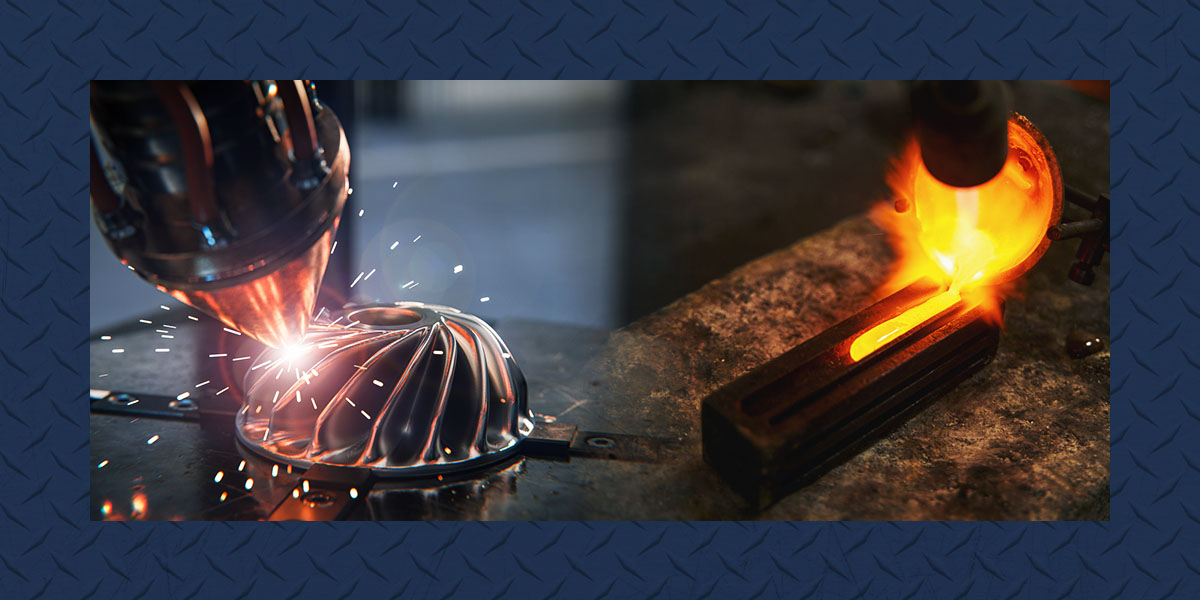
Learn what additive manufacturing (AM) is, how it differs from casting in process and outcomes, and when each approach makes the most sense based on cost, speed, volumes and material properties. We also introduce simple hybrid paths, like using 3D-printed patterns or sand cores, which compress lead time and improve manufacturability while preserving cast metal performance.
We’ll also explore whether additive manufacturing vs. casting is better for your goals, where hybrid options fit and how to move forward confidently.
Quick Answer
For quick, low-volume complex geometry, use additive manufacturing. For scalable, consistent, and cost-effective production, casting is best; hybrids combine both methods.
When to use additive manufacturing or other options, at a glance:
- AM builds parts layer by layer with minimal tooling for rapid iterations.
- Casting involves pouring molten metal into molds to achieve desired properties and lower per-part costs at high volumes.
- Hybrid paths use 3D printed patterns or sand cores to accelerate casting.
What Is Additive Manufacturing?
Additive manufacturing, also called 3D printing, creates parts from digital models by adding material layer by layer. For metals, common methods are powder bed fusion and binder jetting.
AM Strengths
Additive manufacturing offers broad design freedom. It enables internal channels, lattice structures and combines multiple parts into one build. This flexibility improves cooling, reduces weight and assembly points and simplifies operations.
It reduces or eliminates hard tooling, cutting upfront costs and lead times. Direct CAD-to-printing lets teams quickly iterate prototypes, speeding validation and reducing risk before full production.
Practical Considerations
Focus on key factors affecting time and cost. Larger parts take longer to print, but fitting more parts per build improves throughput and lowers cost per part. Decide on orientation, layer height and supports early, as they affect print time, scrap risk and scheduling.
Materials and post-processing are important. AM metals are growing, but not all cast alloys are available or behave similarly. Machining is often needed for tight tolerances and smooth surfaces. To boost density and fatigue strength, you may also need hot isostatic pressing (HIP), a high-pressure heat treatment. These steps boost performance but increase time and cost, so budget accordingly.
What Is Metal Casting?
Metal casting involves pouring molten metal into a mold, where it solidifies into the desired shape before being removed and finished. It reliably produces metal parts of various shapes and sizes with established alloys. It’s ideal for consistent quality, reliable properties, and competitive costs at scale. Molding allows efficient production of both simple and complex parts.
Metal Casting Strengths
Metal casting provides reliable mechanical properties in many non-ferrous alloys like aluminum, brass and bronze. It offers predictable costs at medium to high volumes and achieves precise finishes and tolerances with good process control and machining.
Practical Considerations
Account for initial pattern and core work, which increases lead time but lowers per-part costs at scale. Optimize gating and riser design to prevent defects and maximize yield.
For complex internal passages, expect multiple cores or consider hybrid options like printed sand cores or metal casting from 3D printing patterns to simplify the build and reduce risk.
Side-by-Side Comparison
A direct comparison makes selection faster. Focus on cost versus volume, design complexity and performance, and materials and certification needs.
Cost and Volume
Select the process that meets your run size and total cost targets without sacrificing quality. Consider the following factors:
- AM typically wins for prototypes and low-volume runs because there is no hard tooling, so you can go straight from CAD to parts and iterate quickly.
- Casting has upfront pattern cost, but once tooling is in place, the same mold can be poured repeatedly, driving per‑part cost down rapidly as volumes increase.
- In practice, AM starts faster for first articles, while casting accelerates after tooling release and delivers steady, scalable production lead times.
Geometry and Performance
Match geometry and mechanical demands to the process that meets them reliably:
- AM allows internal passages, lightweight lattices and part consolidation. This enhances cooling or flow, cuts weight and minimizes welds and fasteners for simpler, more reliable assemblies.
- Casting provides strong sections with proven fatigue and strength, ideal for thick walls, thermal stability and predictable performance using standard alloys and treatments.
- Post-processing improves AM and casting by refining tolerances and surfaces, reducing porosity and increasing fatigue life and reliability.
Materials and Certification
Consider alloy availability, qualification pathways and inspection requirements early. Factor in the following:
- The set of printable AM alloys is growing, but whether you can use them for your part depends if they qualify for your application.
- Casting supports a wide range of non-ferrous alloys with known specifications.
- Aerospace and defense buyers should address inspection routes and repeatability.
Combining Additive Manufacturing and Casting
A hybrid approach can offer the speed of AM and the economics and properties of casting. Two common paths are printed patterns and printed sand cores.
3D printed patterns
Printing patterns instead of making wax tooling reduces lead time, allows quick design changes, and minimizes pattern iterations. This speed makes printed patterns ideal for pilot builds and bridge production during validation.
The handoff to the foundry is straightforward and preserves detail. In practice, you 3D print the pattern, commonly via stereolithography (SLA) or printed wax. Then the foundry builds a ceramic shell or sand mold around it, burns out the pattern and pours molten metal into the cavity.
The result is a true cast-metal part with established alloy options and properties, so you get production-relevant performance even in early phases. When the design stabilizes and volumes rise, you can transition to traditional wax tooling to optimize long-term unit cost.
Printed Sand Molds and Cores
Binder jetting prints sand molds and cores directly from CAD, enabling complex internal passages without traditional core boxes. Combining multiple cores into one printed core simplifies assembly, reduces parting lines, and enables features that were previously impractical.
With no core tooling to build, development moves faster and design changes are easier. This improves accuracy in intricate regions and also helps cut scrap. These advantages make printed sand a strong option for development programs and selective production where complexity or timing justifies it.
On precision and quality, recent studies have shown promising tolerances, but some variability still needs control. Handle printed cores like traditional ones: bake, handle, verify dimensions and plan for finishing and inspection. Machining, finishing and inspections are still needed to meet requirements.
When to Use Additive Manufacturing
A short checklist helps confirm AM is the right starting point for your part and timeline if:
- You need prototypes or low-volume parts and expect frequent design changes. Going straight from CAD to print saves time and tooling costs.
- Performance depends on internal channels, lattice structures or complex internal features that are hard or expensive to achieve with conventional cores.
- Your schedule is tight and you need parts quickly for tests or pilot builds, making fast iteration more valuable than the lowest unit cost.
- Available AM alloys and planned post-processing can reliably meet your mechanical property and tolerance targets.
When Casting Makes Sense
Casting is typically the best choice when volumes grow and performance must be repeatable at production scale. Choose casting if:
- Medium or high volumes must hit a specific unit cost and you can amortize tooling over many parts to drive per‑part pricing down predictably.
- Use established alloys with known properties, standard heat treatments, and spec compliance for consistent results.
- Casting and routine machining can achieve your required surface finish and tolerances using standard finish classes and machining stock.
- Life cycle quality assurance, inspection and certifications are essential, including documented process controls, material traceability and non-destructive testing (NDT) within quality systems like AS9100/ISO 9001.
Get Expert Guidance
When speed, cost and properties must all align, early engineering input saves time and rework. A quick geometry and volume review can confirm AM first, casting first or a hybrid with printed patterns or sand cores.
Warner Brothers Foundry Company supports prototypes through production with U.S.-made castings and aerospace-grade quality systems. Contact us today to learn more about the difference between additive manufacturing vs. casting. Our expert team can help you validate the fastest path to production quality.
