

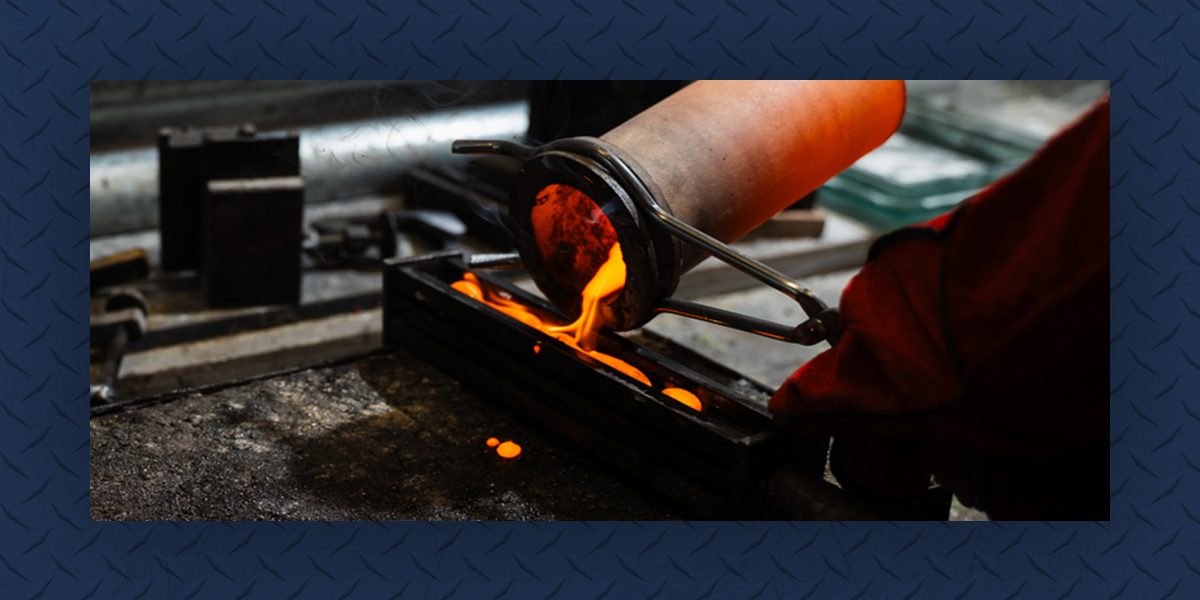
Understanding solidification time before pouring molten metal gives foundries and engineers control over casting quality and design efficiency. Chvorinov’s Rule provides that predictive power through a straightforward mathematical relationship between a casting’s geometry and its cooling behavior. This principle is one of the foundational tools in casting science for predicting how long metal takes to solidify in the mold.
What Is Chvorinov’s Rule?
Chvorinov’s Rule is a physical relationship that predicts the total solidification time of a casting. Nicolas Chvorinov, a Czech engineer, published this rule after observing consistent patterns in how castings cooled and solidified across different geometries.
When molten metal contacts the cool mold wall, a thin solid skin forms at the interface and gradually grows inward. The thickness of this solidified skin is proportional to the square root of elapsed time. Solidification happens quickly at first, then slows as the mold heats up and the temperature gradient decreases.
Chvorinov’s insight was that this process is governed by how much heat the casting holds versus how much surface area is available to release it. A casting with a larger volume relative to its surface area will take longer to solidify than one with a smaller volume relative to its surface area. This relationship applies across casting methods and metal types.
In essence, Chvorinov’s Rule provides a quantitative basis for understanding and predicting how a casting will solidify. Foundries and engineers can use it to design molds and casting processes that produce high-quality parts with desired metallurgical properties.
The Casting Solidification Time Formula
The formula is written as t = B(V/A)^n. In this equation:
- t represents total solidification time.
- V represents the volume of the casting.
- A represents the surface area of the casting in contact with the mold.
- B is the mold constant.
- n is an exponent (typically 2, but can range from about 1.5 to 2.5 depending on mold and metal properties).
It can also be written as t = BM^n, where M = V/A is called the casting modulus.
The Mold Constant (B)
The mold constant bundles together the thermal properties of both the mold material and the metal being cast. It depends on multiple thermal and physical properties:
- Mold thermal conductivity: How readily heat flows through the mold material
- Mold density and heat capacity: The mold’s ability to store thermal energy
- Mold initial temperature: The temperature of the mold before pouring
- Metal density and heat capacity: The casting metal’s thermal properties
- Latent heat of fusion: The energy required to change the metal from liquid to solid
- Degree of superheat: How much hotter the molten metal is above its melting point
B is not a universal constant applicable across all casting scenarios. Instead, it must be determined experimentally for a given combination of mold material, metal alloy and casting conditions. Then, that B value can be reliably applied to predict the solidification times of other castings made under otherwise identical conditions.
The Volume-to-Surface-Area Ratio (V/A)
A thick casting retains more heat internally relative to the surface area available to shed it, so it solidifies more slowly. A thin casting has a proportionally greater surface area, shedding heat quickly and solidifying faster. This ratio serves as a tool to predict relative solidification rates based solely on geometry.
How Chvorinov’s Rule Applies to Different Types of Casting
The time formula itself stays constant across casting methods, but the mold constant changes depending on the process.
Sand Casting
Sand is an insulating mold material with low thermal conductivity, meaning heat escapes from the casting slowly. This results in a higher mold constant and longer solidification times than with more conductive mold materials.
Variations in sand type and composition can influence the mold constant and, therefore, the solidification behavior:
- Moisture content: Sands with higher moisture content tend to extract heat faster than completely dry sands. The latent heat of the vaporization of water absorbs energy from the casting, increasing the heat transfer rate and lowering the B value.
- Binder type and density: The type of binder and the packing density of the sand affect its thermal properties. Denser molds generally conduct heat slightly better.
- Grain size and shape: Finer sand grains can create a denser mold with more contact points, potentially slightly increasing thermal conductivity, though the insulating nature of sand remains dominant.
Plaster Mold Casting
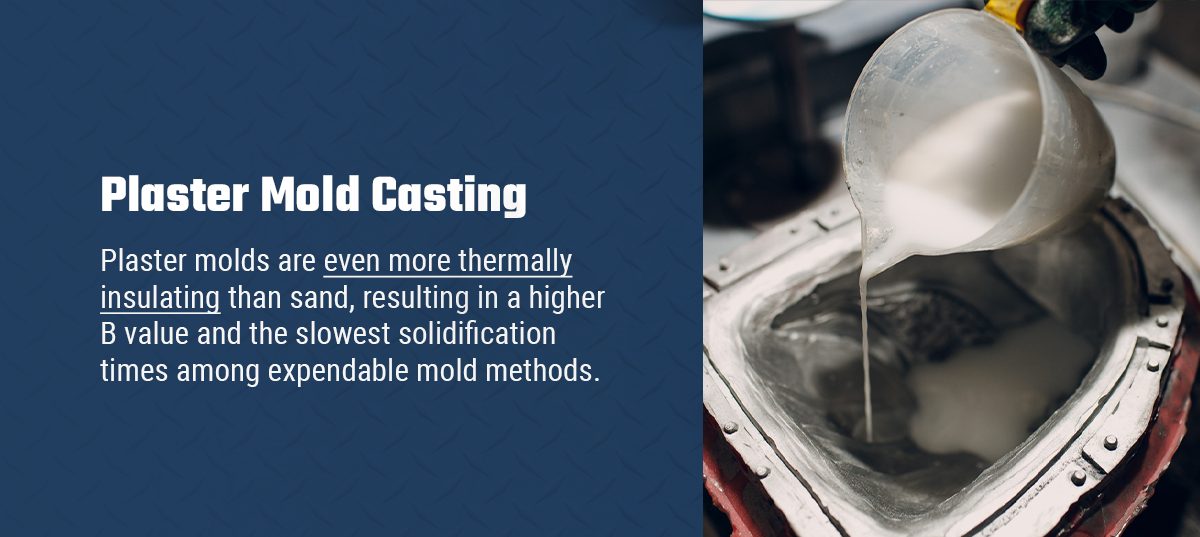
Plaster molds are even more thermally insulating than sand, resulting in a higher B value and the slowest solidification times among expendable mold methods. This extended solidification produces very fine surface detail and smooth finishes, making plaster mold casting well-suited for intricate non-ferrous parts. The slow cooling also means longer cycle times, which is the trade-off for superior surface quality.
Permanent Mold Casting
Permanent molds are made of metal, which has high thermal conductivity. Heat is extracted from the casting much more rapidly, resulting in a lower B value and faster solidification times. The practical effect is finer-grained structures and improved mechanical properties in the finished casting, but reduced design flexibility and higher tooling costs. Chvorinov’s Rule still applies, but B must be re-determined for the metal mold environment.
Investment Casting
Investment casting uses a preheated ceramic shell mold, so the initial mold temperature is high. This reduces the temperature differential driving heat transfer and results in slower cooling. The approach is deliberate and allows the metal to fill thin and complex sections before freezing. The mold constant B must account for the mold temperature, and Chvorinov’s Rule remains applicable, but the B value will be higher than it would be for the same metal in a cold sand mold.
Using Chvorinov’s Rule for Riser Design
A riser is a reservoir of molten metal attached to the casting that feeds liquid metal into the part as it shrinks during solidification. The riser must solidify after the casting. If it freezes first, it can no longer feed the casting and defects form. Chvorinov’s Rule is the standard tool for ensuring this sequence.
Since both the riser and casting are made of the same metal in the same mold, B cancels out when comparing their solidification times. The comparison reduces to their modulus values (V/A ratios). A riser with a higher modulus than the casting will solidify more slowly, maintaining the liquid reservoir until the casting has fully solidified.
Surfaces shared between the riser and casting are excluded from the area calculation because they do not contribute to heat loss. Only the external surfaces that contact the mold drive cooling. This principle allows foundries and engineers to size risers appropriately and deliver premium-quality castings with minimal internal defects.
Work With Warner Brothers Foundry Company on Your Next Casting Project
When your project demands precision castings backed by rigorous engineering, consult us at Warner Brothers Foundry Company. Since 1955, we have delivered aluminum, brass and bronze castings to aerospace, defense, automotive and commercial industries using air-set sand processes. Our team works with you from design through production.
Call us at 586-773-0858 or fill out our online form to discuss your next casting project.