

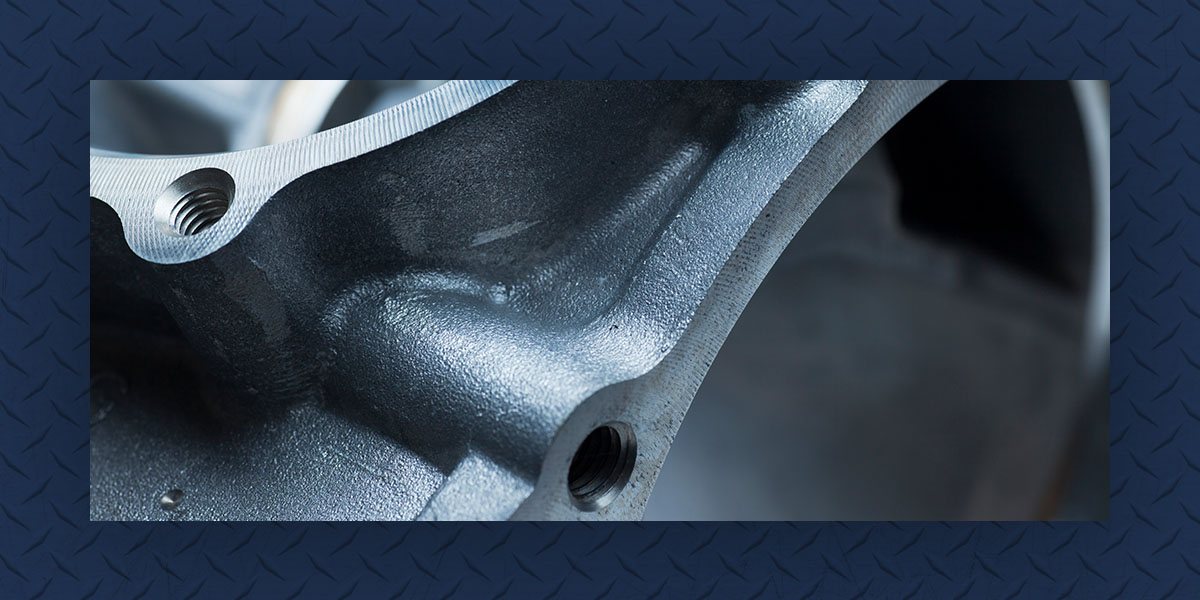
Engineers often focus solely on alloy selection and dimensional accuracy when specifying a metal component. However, the benefits of surface finish in sand casting are a crucial and frequently misunderstood aspect of part design.
Many people mistakenly believe that a rougher as-cast surface is inferior. However, sand casting creates a uniquely textured finish that can reduce costs, improve performance and enhance durability. Understanding the functional advantages of a standard sand-cast finish will help you optimize your designs for the budget and application at hand.
Understanding Surface Finish in Metal Casting
In manufacturing, surface finish describes texture, as quantified by measurements like roughness average and root mean square. While a lower number indicates a smoother surface, a higher number does not necessarily imply an inferior part.
You should have realistic expectations for these different processes.
- Sand casting: Produces a standard finish in the range of 300 to 560 RMS — the baseline for a reliable and cost-effective casting.
- Shell molding: Offers a finer finish, typically between 50 to 150 RMS.
- Investment casting: Achieves the smoothest surface finish, often 63 to 125 RMS, but at a significantly higher cost.
A part’s functional surfaces are often a tiny percentage of its total surface area. Engineering the appropriate finish for each component is the most efficient path.
3 Benefits of Standard Sand-Cast Finishes
For many applications, the standard 300 to 560 RMS finish of a sand casting provides distinct advantages over smoother, more expensive alternatives.
1. Cost Efficiency
Achieving a smooth surface finish directly from a mold requires specialized processes, finer sand aggregates or secondary operations like extensive machining. Each of these steps adds time and cost to a project.
You can eliminate these unnecessary expenses by accepting a standard sand-cast finish on noncritical or non-mating surfaces, like the exterior of a housing or the body of a bracket. For this reason, sand casting is one of the most cost-effective methods for producing durable, reliable metal parts.
2. Enhanced Coating Adhesion
The textured surface finish of a sand casting creates an anchor profile. These microscopic peaks and valleys provide an exceptional mechanical grip for paints, powder coats and other protective layers.
Unlike a perfectly smooth surface that ultimately allows coatings to peel or chip, the anchor profile locks the coating into place, resulting in a far more durable and long-lasting finish that can withstand harsh industrial or environmental conditions.
3. Robust Aesthetics
The industrial matte finish of a sand casting is highly practical for parts used in heavy machinery, automotive and military applications. The textured surface naturally hides minor imperfections, handling marks and fingerprints that would be highly visible on a metal surface finish or polished part. This rugged aesthetic ensures the component maintains its appearance through shipping, installation and regular use without requiring delicate handling.
The Importance of Surface Finish
While the standard sand-cast finish is ideal for structural integrity and cost savings, some functional interfaces require a higher degree of smoothness. Critical areas like O-ring sealing grooves, hydraulic fluid pathways and precision mating surfaces often demand tighter control than a raw casting can provide.
To bridge the gap between standard cast finishes and precision requirements, foundries employ several post-processing techniques to enhance surface quality where the design necessitates it.
- Shot blasting: Beyond simple cleaning, the blasting process uses high-velocity abrasive media to remove residual sand and scale and create a uniform, matte texture across the part. Shot blasting improves aesthetic consistency by optimizing the surface for painting or plating.
- Sanding and polishing: Skilled craftspeople use belt sanders and polishing wheels to refine components that require a visual impact or a smoother tactile feel. Sanding and polishing are particularly effective for blending parting lines or smoothing surfaces that will be visible to the user.
- Precision machining: Machining is the solution when operations require maximum precision. Foundries often machine critical faces, bore holes and cut threads to tight tolerances. By machining only the functional features and leaving the rest of the body as-cast, engineers can maintain the cost-effectiveness of surface finish sand casting while achieving the precision of a fully machined part.
The Shell Molding Advantage
Shell molding may be ideal for projects where the entire part requires a finer finish directly from the mold, without the added cost of secondary polishing. Unlike standard sand casting, shell molding uses finer, resin-bonded sand that cures against a heated pattern, resulting in a significantly smoother cast surface, typically 50 to 150 RMS, and sharper dimensional detail. It’s an excellent choice for complex geometries that need a step up in finish quality.
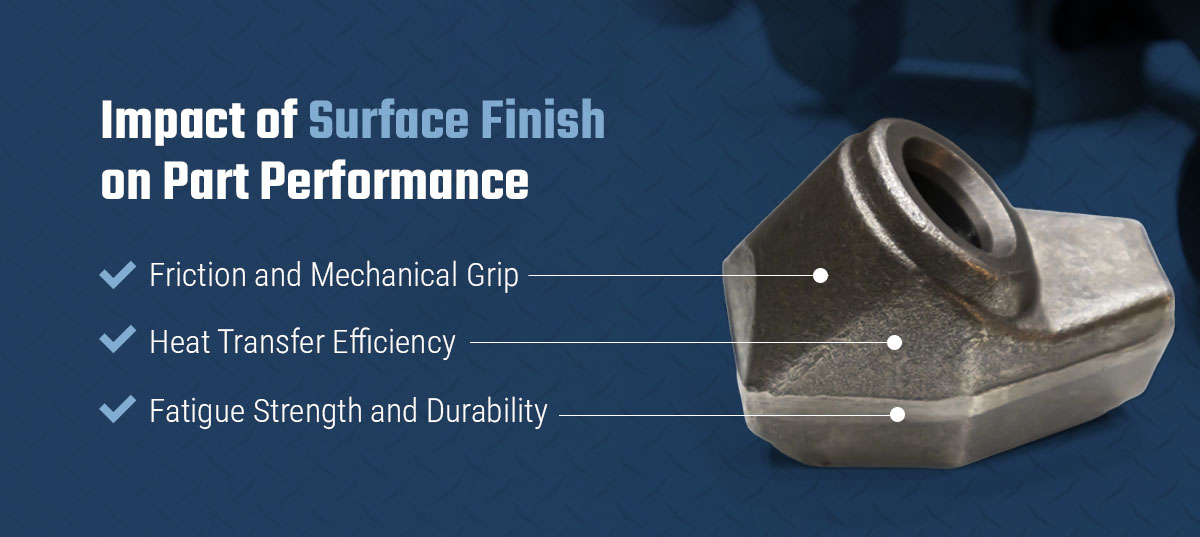
Impact of Surface Finish on Part Performance
Surface finish sand casting is a functional engineering specification that dictates how a component interacts with its environment. The microscopic texture of the metal affects operational success, whether the part is bearing a load, dissipating heat or mating with another assembly.
Friction and Mechanical Grip
A casting’s texture directly determines the amount of grip it provides. A rougher surface creates higher friction, which is a competitive advantage for safety-critical parts like cast foot pedals, step treads or heavy-duty clamps that need to hold tightly. Conversely, for parts that must slide against soft seals or bearings, this same roughness would cause abrasion, making a smooth, machined finish necessary to prevent wear.
Heat Transfer Efficiency
Thermal management often relies on maximizing surface area. In components like heat sinks, cooling fins or engine housings, a sand casting’s irregular texture effectively increases the total surface area available for convection compared to a polished surface, which can enhance heat dissipation rates in passive cooling applications.
Fatigue Strength and Durability
In high-cycle fatigue applications involving intense vibration, surface imperfections can act as micro-notches or stress risers where cracks may initiate.
While critical aerospace components often require a finer cast surface smoothness to mitigate this risk, standard sand-cast finishes are structurally sufficient for the vast majority of static components like pump housings, manifolds and mounting brackets. For these parts, the cost of smoothing the surface usually yields no functional increase in part life.
Optimizing Your Casting Design for Cost and Quality
The most effective way to balance performance and cost is to clearly communicate finish requirements. Engineers can mark their drawings to specify which surfaces require a fine finish and which can remain as-cast. Leaving noncritical surfaces with a conventional sand-cast finish is a simple and effective cost-saving strategy.
Involving the foundry team early in the design process is essential. Their experts can provide guidance on the most efficient way to achieve your design goals. As a premier American foundry, Warner Brothers Foundry Company prides itself on helping you create the best possible part for your budget.
Request a Quote for High-Quality Sand Castings
Choosing the appropriate cast surface smoothness requires a partner who understands the balance among cost, quality and performance. Warner Brothers Foundry Company has over 70 years of experience producing high-quality aluminum sand castings for many industries. Our experts are ready to help you optimize your design for maximum value and reliability.
Contact us today to submit your drawings for a surface finish feasibility review. We will help you determine the most effective and economical path for your project.
